
I think for most children it all starts unconsciously as they fall asleep, a thread being spun on and on, a couple of illustrations glimpsed on a wide, smooth surface and then, eyes closing, a couple of rounded colourful figures still bouncing in the mind – animals: certainly a rabbit wearing a jacket, easy to recognise every time. The mother’s voice goes on: no plot, just an expression of care, until it fades; and tomorrow night, it will start again.
Many years later my mum asked me if I remembered how much she read for me, but to her disappointment, despite the long hours she spent reading to make me fall asleep, my memory of those evenings has faded almost completely now; and even then, it only left a vague mark. Something very crucial remained, but it is hard to say what: perhaps the knowledge that books are familiar things laying around which can be opened, and the adults opening them always look very interested – which makes you want to open them too and gaze at the mysterious black signs.
The moment I realised I could read and write by myself was likely a solemn one, decorated with fat and leggy ciphers. There were still people reading for me: I remember my primary school teacher sitting on a chair at the front of her desk, obstinately reading page after page of The Little Prince over many sessions. We could hardly bear our boredom: it was about this child – but it sounded more like the teacher’s preaching voice disguised as a child – wearing a light blue cloak and travelling to planets; no other memorable characters, except a flower who insisted on being watered every day to become the little prince’s friend.
But luckily I soon began to associate books with a much better experience. My grandmother, on my visits to her city by the sea, sometimes took me with her to the bookshop. These trips involved what seemed to me very serious business transactions. My grandmother handed over a couple of her own books to the man who worked there, and both of them became absorbed in an endless, excited conversation, at the end of which she got from the man a pile of new books. I found out later that, because she was a devoted client, the bookshop allowed her to return the books she didn’t like in exchange of new ones.
While my grandmother and the man were talking, I was usually left to browse in the children’s section, which was in a dedicated room. The books there were much more colourful and appealing than in the rest of the shop, with intriguing titles mentioning ‘adventures’ or ‘chocolate’ or ‘witches’, with wondrous animals and naughty children stamped on the covers. There I was free to explore for a long time, until my grandmother had done talking to the man, and contrary to what was the rule in all the other toy shops, I was allowed to choose whatever I liked. These were delightful afternoons. After a few other errands in the city centre we came back home in the twilight, refreshed by the sea wind, and we put our respective book piles next to each side of the big bed.
Some time after dinner, when it was time to go to bed, and I had passed all the checks that I had washed my feet and said my prayers, we both lied down by our reading lamps and enjoyed the best part: choosing which book to read first. At some point, my grandmother would say that we had to switch the lights off – I was already allowed to stay up much longer than the majority of children – but I knew that if she woke up in the middle of the night, as it happened quite often, she would switch the light back on to keep reading.
My mother was ambivalent regarding these trips to the bookshop. She said that my grandmother was buying me books which were too many and too difficult, risking that I may end up hating them. Indeed there were a few of those books which I effectively couldn’t read, but overall her fear proved wrong. In fact, there is something special in the experience of reading a novel without understanding most of it, which is bound to be lost in adulthood. As adults, we are used to understanding all the words in a novel we are reading for pleasure: when we don’t, we put the novel down. If for some reason we need to keep reading – if, say, we are learning a foreign language, or studying a challenging classic, the effort is frustrating. But as children the effort makes us proud.
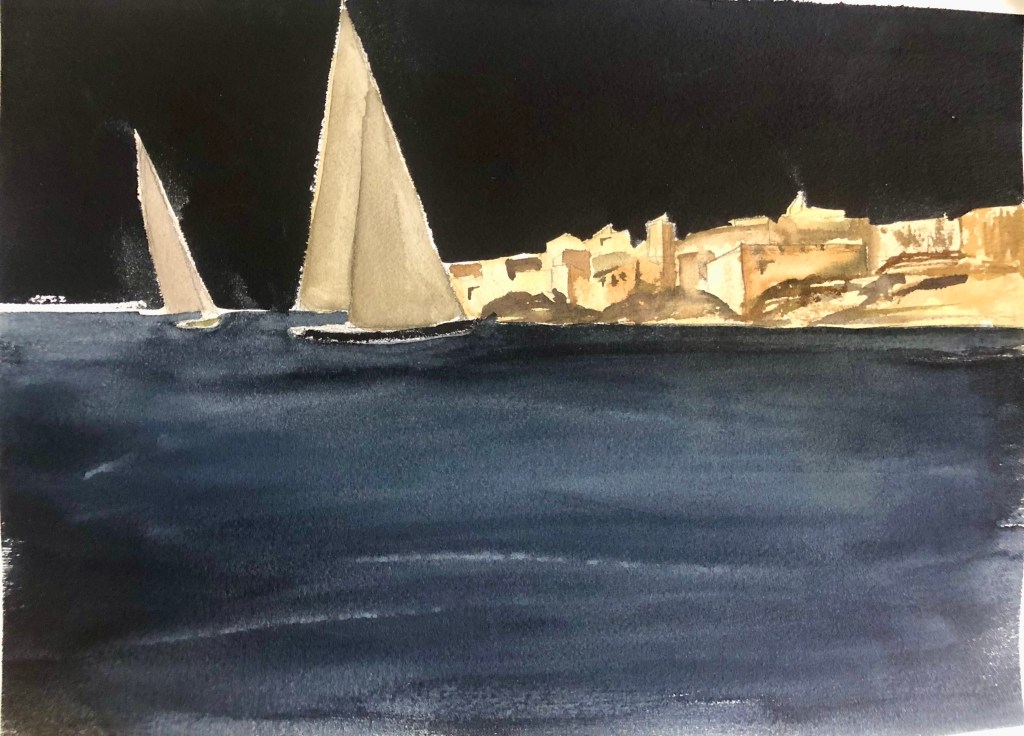
I still remember the suspense I felt as I tackled the first couple of pages of a novel for older children to see if I managed to make up a scene out of the very few words I could understand. The most challenging were the nineteenth-century sea adventures. Those novels were teeming of unknown vocabulary referring to all the parts and objects of a ship, and were populated by bearded and cold-hearted sailors who uttered scarce and enigmatic sentences. I could identify with nothing other than their survival instinct, and at the time it seemed to me that indeed those tales conveyed no other emotion. But as soon as I could somehow see the ship, with its sails and ropes, establish whether it was fine or bad weather, and invent a reason behind the words muttered by the sailors, my pride and excitement were immense. Here I was, on a ship headed to the unknown.
Another unique aspect of children’s reading is their complete ignorance of the fact that books are differentiated by genre, language, culture, popularity, ideology. Children only have a vague perception of time: if a novel contains horse carriages, then it must have been written (or set, but the distinction is not clear) in the past. They can also recognise the difference between an adults’ book and a children’s book. Of all other distinctions they have no notion. Books lay around the house, all equal. I remember finding in the dusty bottom shelf of a bookcase, where I had never seen anyone looking, a novel whose beginning, in my half-understanding way, very much intrigued me. I thought it was my personal discovery. It was The Mill on the Floss, and I was stung by disappointment when I found out, years later, that it was already very famous.
If finding books in various corners of the home was a winter activity, summer reading had a whole different flavour. Summers were extraordinarily long back then, and they could be filled entirely by a big book: Gone with the Wind, Jane Eyre. A book’s adventures, added to my days, would become inseparable from the experience, memory and smells of a particular summer. Stretching uncomfortably on a rocking chair, on sun-patterned grass, or on a bed left unmade behind closed shutters shielding the hot afternoon, I felt a strong desire to be there, in the novel’s world. I didn’t want to take part in the story as myself, but dreamed to become one of the book’s characters – and I believed I could, one day, if only I chose to.
Looking at stories through clear waters, children pass easily into the worlds reflected in them. The summer hours extend their arms, not daring to touch their absorption, and time tiptoes respectfully round them. But adults’ wish to escape into another world is checked by the awareness that any fictional world is a fringed disguise of their own: where they find their pain multiplied and varied, and their joys clouded and unreal. Even if my grandmother managed to retain some of children’s way of reading – her eyes still brightened at the glimpse of a castle, a witch – she also took up many an austere volume with an inexplicable sigh. Some books seemed quite heavy as she limped to her bedside table to add them to her pile.
It is not long before children’s clear waters get muddled too. In their teens, they find something about themselves that they don’t like, or understand, and begin to look for traces of it in the books they read. Some of these are dumb – their stories grow distant. Some of them instead open up corridors of unhoped-for understanding, of warm, alluring intimacy, in which they gratefully melt. But one after the other, these unfolding corridors, lined with innumerable mirrors, bend, interlace, encircle the young readers – slowly closing round them.


Leave a Reply